Showing posts with label Swales. Show all posts

Thursday, September 10, 2015

7 Layer Food Forest

     If you've ever been able to enjoy a walk in the woods, you've probably never come across someone watering the trees in the middle of the woods. Why is that? Do the trees in the woods need water? What about nutrients to grow? Where do they get what need to live?

Image source: Permaculture a Beginner’s Guide, by Graham Burnett

     Mother nature has a way of doing what it wants, eventually. Even if humans destroy our ability to live on Planet Earth, she will eventually fix

Wednesday, September 2, 2015

Earthworks - Swales

The sun shines. The water evaporates. The gas condenses. The droplets fall. The water runs downhill as it gathers. This process happens whether we want it to or not. We can try to lessen the damage from this OR we can use it to our advantage. We chose to make it an asset.


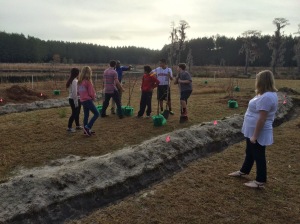
We began to dig so we could slow down the movement of water. The swales, or ditches on contour, that we created will stop the water and help it accumulate and soak the ground around out plants. If it rains hard enough, it will fill the swales and continue flowing downhill and fill another swale. This repeats until the water, if there is enough, flows down into the pond like it would have without the swales.

This feature in our food forest helps us to lessen the need for water and also creates a small habitat for moisture-loving organisms. Later we filled these swales with old pine branches so that the water would be able to soak the branches and keep that area moist. In time, those branches will break down and turn into moist soil that abounds with fungal, bacterial, and plant life. 

The Genesis

     In the Spring of 2015, some Pine Grove students began building what would eventually become the first stage of the PGM Food Forest. A food forest is a forest garden that is full of perennials that produce food year after year after year. The goal of the project was to create an ecosystem that would be able to thrive with less resources than a normal garden and, eventually, turn into a self sustaining forest.
     When these middle schoolers look at the hundreds of acres that surround the campus, they realize that no one waters the trees. No one pulls weeds. No one sprays insecticides to control pests. All of these things take care of themselves in a way that creates a home for plants, animals, bacteria, fungi and protists. This is what these students set out to reproduce. This is the starting point for permaculture projects.
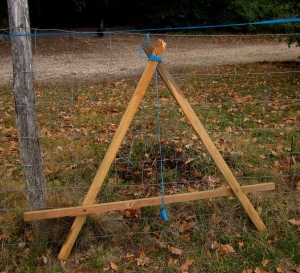
IMG_0962     a-frame picture
     Mr. Hurley and Mr. Collins built an A-frame level  that would show where the contours, or level parts, of the land were. These tools were very simple to make and both teachers explained how they were built and how they worked to the class. The kids seemed mildly interested in the "how" and more excited to actually go outside and work. That's right. They want to work outside. Kids often don't get enough time outside and this is one of our reasons for creating the food forest: kids need to get their hands dirty and have fun in order to learn on a deeper level.
     As we headed outside, there was a crispness in the air and the students were giddy. They most likely didn't completely understand what the final product was going to look like but they were excited to begin.